Signed in as:
filler@godaddy.com
Mark Fisher [1]
A Haunted River will acknowledge and build upon the work the Guardians have already undertaken. Throughout this programme we will go on field trips, undertake citizen science, conservation and embodied artistic practices. Together we will explore migrations, life cycles and ethnobotanical approaches, re-thinking our relations with the beings and life in and around the River Itchen. How can we tap into, and feel the weight of futures that never arrived? What possible futures could this river still hold? The Guardians of the River Itchen will bring their own knowledge, their own bodies and their own futures to this work.
Astrida Nīemānis [2]
Rivers carry time differently to humans. The Itchen is not simply water moving through Southampton — it is a living archive: buried channels, ecological memory, the traces of intervention and coexistence accumulated across millennia. Our historical records only reach so far. But the deep geological past speaks in other ways — in the memory held by Atlantic Salmon, who once returned in great numbers each year to spawn in these very waters. Now, due to the climate emergency and centuries of human activity, they return
in critically few numbers. Their diminishing presence is one of the river’s most urgent hauntings.
A Haunted River draws upon the ideas of hauntology, a term coined by the French philosopher Jacques Derrida who used it to describe a nostalgia for lost futures. [3] British Cultural Theorist Mark Fisher then took this further, applying hauntology to music, art and popular culture in his writings. [4] To be haunted, in Mark Fisher's sense, is not to be visited by the past but to feel the weight of futures that never arrived.
We will think through this critical lens, applying it to the river’s socio-ecology, to consider the river that could have been, the city that might have grown differently around it, the ecologies that were cancelled before they could flourish. What futures does the River Itchen still hold in potential, unactivated, waiting?

Anna Tsing [5]
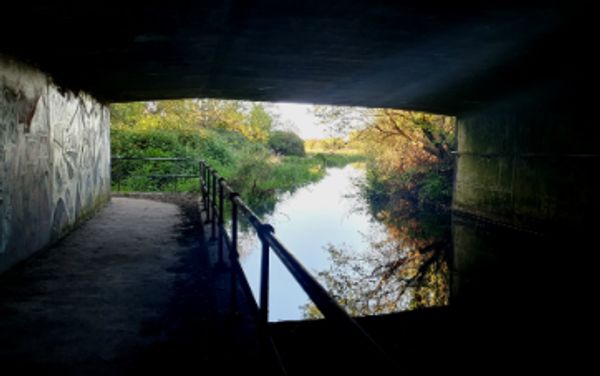
The programme begins with a simple question: Where is the river? The river runs beneath roads, through culverts, along edges we rarely visit — its older routes buried, redirected, forgotten. Multiple, often competing demands are placed upon it: the need for clean drinking water, flood mitigation, public health, ecological richness, and the pressures of a growing city. And yet, despite everything, life persists wherever water finds a way.
We will listen to the life that persists where it finds a way. On our art-walk, we will trace where the river goes, following clues of its past. Later, we will listen again, travelling to another nearby river, the River Avon in Salisbury — a sister chalk stream, seeing how the landscape has been shaped by human and non-human forces across centuries. Asking what one river can teach another - kinship and difference held in the same breath.
Going onto the water itself, we move through the river rather than alongside it — briefly inhabiting its own temporality: slow and ancient.
Alexis Pauline Gumbs [6]
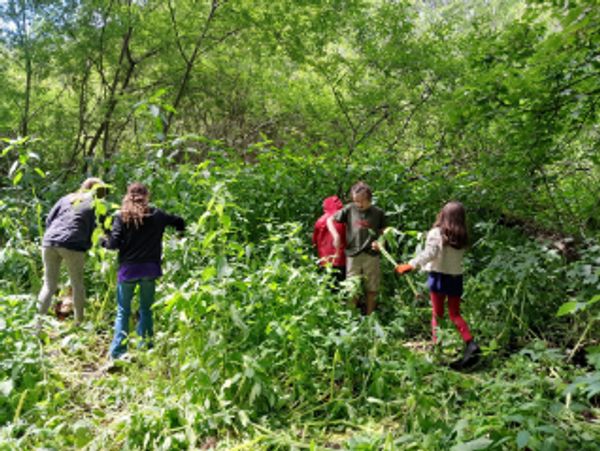
If the first movement is about listening, the second is about feeling the river's memory through our own bodies. Drawing on the work of Isabel Lewis, the programme asks: what does a river feel in its body? Through choreography, and a sensory swing, participants attune to the Itchen's logic — its flow, its deposits, its drift — as if the body itself might become a site where the river's unactivated futures can be sensed and rehearsed. This embodied attunement extends to plants. The Himalayan Balsam — labelled invasive, pulled from riverbanks across Britain — is itself a kind of ghost: a traveller from elsewhere, carrying histories of colonial botany, trade routes and displacement.
Through an ethnobotanical lens informed by the work of Alaa Abu Asad, we ask what the language we use about this plant — ‘invasive’, ‘alien’, ‘out of place’ — reveals about how we think about belonging, migration and the social-ecological futures we have already given up on without noticing. The Balsam then becomes both subject and medium: its own pigments are used to make slow, light-sensitive anthrotype photographs that may take days or weeks to fully emerge — a deliberate refusal of the instant image, an insistence that some futures must be waited for.
Glenn Albrecht [7]
Fisher wrote of listening for "relics of the future in the unactivated potentials of the past." The Itchen's riverfly populations are exactly this: living indicators of an ecological balance that once existed and might exist again, readable only if we know how to look. Underwater photography opens another world — one that persists beneath the surface, largely invisible to human consciousness, haunting the city from below.
At Chessel Bay — one of Southampton’s four Sites of Special Scientific Interest — the accumulation of plastic nurdles and other pollution on the tidal shore makes the scale of the pollution crisis visceral and immediate. Nurdles are the tiny raw pellets from which all plastic products are made; they escape into waterways in vast quantities and are virtually impossible to fully remove. Like everything the tide brings in, they keep returning. The creatures that live here — invertebrates, wading birds, fish — encounter them constantly. A litter pick is an act of care — but also of reckoning: what does it mean that a protected nature reserve requires this kind of constant human intervention simply to survive?
Ann Laura Stoler [8]
Hauntology insists that what is absent from the record is as significant as what was captured. The Southampton City Art Gallery archive reveals not just the River Itchen across time, but the selective vision of those who looked at it — what was valued, what was overlooked, whose relationship to the river was considered worth preserving.
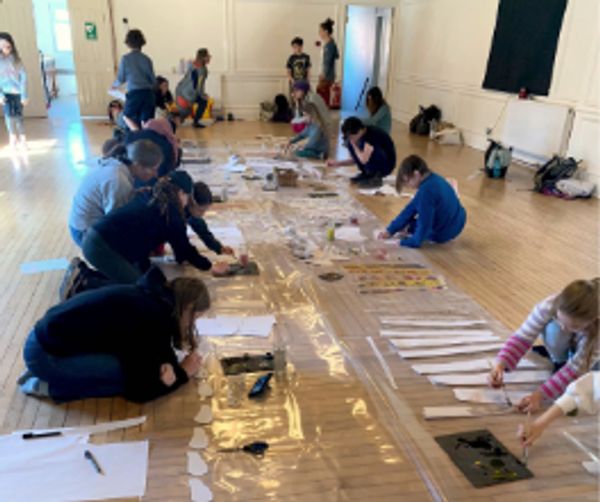
Artist James Aldridge's workshop at Chessel Bay offers a counter-practice: slow, sensory, multiple, shaped by a neurodivergent attention to detail and accumulation. His practice insists that the river contains more than any single image or dataset can hold — that to truly know a place, you must be willing to gather, collect and sit with what doesn't yet resolve into meaning. Alaa Abu Asad's interrogation of plant language and colonial history argues that names are never innocent. The stories we tell about species, places and rivers determine which futures we are able to imagine — and which we have already given up on without noticing. The archive tells us what was valued. These practices tell us what was missed.

Ursula K. Le Guin [9]
Fisher described one function of hauntology as "keeping insisting that there are futures beyond postmodernity's terminal time." This is what the programme's final movement asks of its participants, to imagine beyond now, beyond capitalism. At St Denys Carnival, the Urban Wild Festival and the pilgrimage: River Itchen Rising?, art made in response to the river is taken into public space — not as decoration but as demand: a campaign message and a refusal to accept the river's diminishment as inevitable.
The culminating Trifest celebration brings the full arc into view: fourteen weeks of looking, creating, mourning, collecting and imagining alongside a river that has its own temporal logic, its own memory, its own unfinished futures still waiting to be activated.
The River Itchen is full of relics. This programme ends not with answers but with a sharpened capacity to attune, and to act — through art, science, conservation and collective voice — to demand an ecologically prosperous future for this river and the lives entangled within it.
Gemma Gore, April 2026.